
Privacy and security, in plain language
Your household’s money, documents and plans are personal. This page explains what we store, who can see it and how it is protected. We only describe controls we have in place.
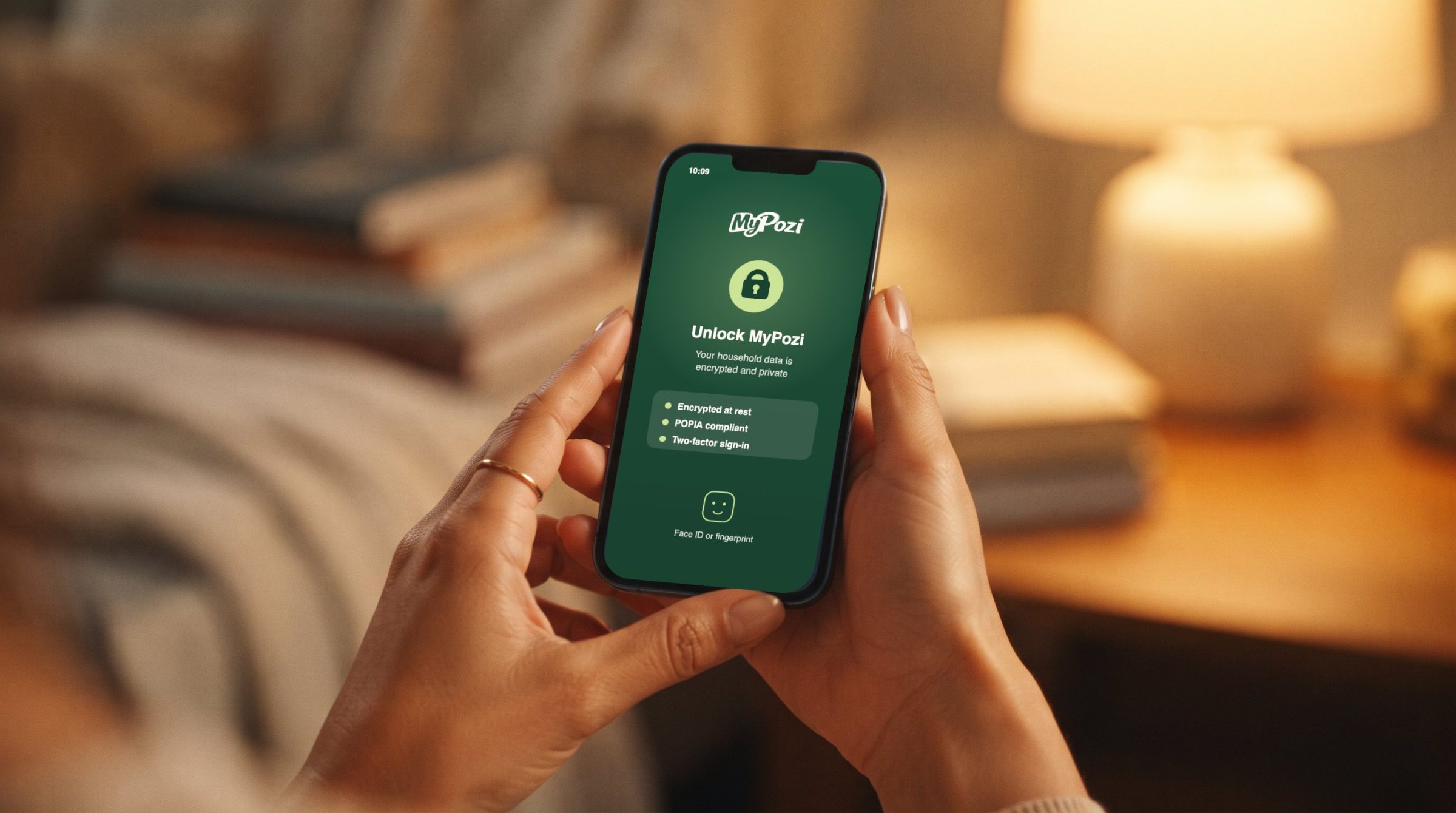
Private by default.
Your household data is encrypted and only the people you invite can see it.
Summary
- We store what you add to MyPozi so your household can use it. We do not sell it.
- Everyone you invite sees the household’s shared records, and roles decide who can change them. Each adult’s own answers about their work and gender, and each person’s support requests, are not shared with the household.
- MyPozi does not connect to your bank or move money.
- While your household is active, you can export reports and transactions as your plan allows, and the owner can delete the household at any time.
What we store
Account details for each member who logs in: e-mail address, name and sign-in sessions (passwords are kept only as a secure hash). The household information you add: the people in the household, including children and people without a login (names and birth dates), budgets, transactions, goals, calendar events, tasks, documents, contacts, greetings and the people they go to, settings, and your answers to the household questions (for example about your home, vehicles, pets, medical cover and how you handle money). Each adult’s own answers about their work and, when we ask, their gender, which only that adult can see. The figures we work out from these records for your reports and for internal service statistics: only our Super administrators can see statistics across households, some figures may cover only a few households, and we do not publish or sell them. Your choice about product e-mails, and a few records of getting set up (e-mail confirmed, household created, first budget saved). A message sent through the contact form keeps your name, e-mail address, message, the page you sent it from, any campaign tags in the link you arrived from, and your IP address and browser; it is not linked to a household.
We measure how our website is used: which pages you visit, for how long, and which buttons you press. This shows us which pages help people decide and where our sign-up form gets in the way, so we can make them clearer. On our sign-up form, and on the screen where you enter the code we e-mail you, we also record each step. That is which fields you use, whether each was left empty, accepted or refused, whether your account request and your code went through, and how long that took. We never record what you type, including your password and the code, or any amounts.
We keep these sign-up steps, and the sign-up buttons you press, in our own database. With them we keep the page where your visit began, where you came from, the kind of device you use and the country you visit from. They are held under a measurement pass that your browser keeps for up to seven days. If you create an account in this browser, we connect that pass to your account, so its steps sit beside your name and e-mail address. We do this when you confirm your e-mail address, and otherwise within about a day, even if you never confirm it. A daily clean-up deletes each pass and its steps 90 days after the pass began.
We also send measurements to Google Analytics, using Google’s own measuring code on our website’s pages. Google receives the pages you visit and how long each was in use, the buttons you press and whether your sign-up was started, sent and accepted, with the plan and billing period you chose, and whether you sent us a message through our contact form, never the message itself. It does not receive the steps of each field. With them go the page address without anything after it, the page’s title, the website you came from or the campaign label in the link you followed, the kind of device, browser, operating system, screen size and language, and a random number and a session number that Google’s cookies keep in your browser for up to 13 months from your first measured visit. Google works out your town or city, province and country from your network address and does not store that address. We never send your name, your e-mail address or what you type. Google processes the measurements for us, outside South Africa. Under our settings, it keeps detailed records for up to 14 months after your browser’s last measured visit, and its summary reports without that limit. This measurement never covers the app or your account pages.
You can turn measurement off for this browser at any time with the button below. Nothing more is then measured in this browser, and it removes its random numbers, Google’s cookies and its measurement pass. When your browser tells our server, we delete the steps held under that pass and any connection to your account. It tells us at once or, if you were offline, the next time you open our website. Steps held under an earlier pass go in the 90-day clean-up. If your account is deleted, we delete the steps connected to it. What Google has already received stays with Google. Your browser keeps this setting until its data for our website is cleared, and you can turn measurement back on here.
Measurement is on for this browser.
Who can see it
Every household has an owner. The owner gives each member a role. Each adult’s own answers about their work and gender are seen only by that adult, and each person’s support requests only by them and our support staff.
| Role | Can see | Can change |
|---|---|---|
| Owner | Shared records | Everything, including logins, billing and deleting the household |
| Admin | Shared records | Everything except logins and deleting the household |
| Member | Shared records | Adds and changes records; some deletions need an owner or admin |
| Read only | Shared records | Nothing |
Where it is stored
Household data is stored with Supabase (on Amazon Web Services) in London, United Kingdom.
How it is protected
All traffic between your device and MyPozi uses HTTPS. Stored data is encrypted at rest by our hosting provider and backed up daily, and each household’s records are separated by database access rules. Staff use MyPozi’s admin tools under named roles, and technical access to the database is limited to the people who maintain MyPozi.
Your rights
We process personal information in line with the Protection of Personal Information Act (POPIA). You can ask to see, correct or delete the personal information we hold about you.
Deleting your data
The household owner can delete the household from Settings, even while it is paused. Its records and stored files are then deleted. Seven days is how long our database backups are kept, so a deleted household can stay in a backup until that backup expires. Some records outlast the household: messages sent through the contact form, which are not linked to a household; payment records, reduced to what accounting needs; a record that the deletion took place, which does not name the household but notes who asked for it; security records of staff actions in our admin tools; figures derived from its records in our internal statistics, until those statistics are next rebuilt; and the hosting providers’ own logs, which they keep for their own periods.
Contact
Questions about privacy: privacy@mypozi.com.